
How Compound Interest Builds Wealth: The Simple Strategy That Can Turn Small Investments Into a Fortune
Discover how compound interest can transform small, consistent investments into significant long-term wealth—and learn the simple habits that allow time, patience, and reinvested returns to work in your favor.
7/23/20266 min read

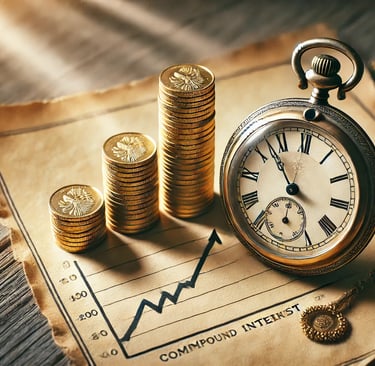
What if the most powerful wealth-building strategy had nothing to do with predicting the next successful company, finding a secret cryptocurrency, or earning an enormous salary?
For many investors, the real advantage is much simpler: investing consistently and allowing their returns to generate additional returns.
At first, the progress may appear disappointingly slow. Your account grows by a few dollars, then a few hundred. It may feel as though nothing important is happening.
But compound interest works quietly.
Given enough time, those small gains can begin producing gains of their own. Eventually, the money you invested may contribute less to your growth than the returns generated by everything already accumulated.
That is when compounding becomes powerful.
What Is Compound Interest?
Compound interest is the process of earning returns on both your original money and the returns that money has already generated.
Investor.gov describes it as interest paid on the principal and on accumulated interest.
Imagine investing $1,000 and earning a hypothetical 7% annual return.
After the first year, you would have $1,070.
During the second year, the 7% return would not apply only to your original $1,000. It would apply to the full $1,070.
Your money would therefore grow to approximately $1,144.90.
The extra amount may seem insignificant at first. However, the process continues year after year, with each new return becoming part of the amount that can generate future growth.
The truth is that compounding rarely looks impressive in the beginning.
Its greatest results appear near the end.
Why Time Matters More Than Most People Realize
Money is only one ingredient in compound growth.
The other is time.
Consider a hypothetical $1,000 investment earning an average annual return of 7%, with all returns reinvested and no additional contributions:
After 10 years: approximately $1,967
After 20 years: approximately $3,870
After 30 years: approximately $7,612
After 40 years: approximately $14,974
No additional money was invested in this example.
The investment simply had more time to grow.
Of course, real investment returns are not fixed or guaranteed. Markets rise and fall, and taxes, inflation, and fees can affect the final result.
Still, the example reveals an important principle: starting earlier can reduce how much of the financial burden must be carried by your own contributions.
Time begins doing part of the work for you.
Small Monthly Investments Can Become Significant
Many people delay investing because they believe a small monthly amount will not make a meaningful difference.
But consistency can be more important than beginning with a large amount.
Suppose someone invests $100 every month for 40 years and earns a hypothetical average annual return of 7%, compounded monthly.
The person would contribute $48,000 of their own money.
The account could grow to approximately $262,000 before taxes and fees.
Most of that final amount would not come directly from the investor’s contributions. It would come from growth generated over time.
This is an important distinction.
The investor did not need to deposit $262,000. The combination of regular contributions, reinvested returns, and time created the difference.
Small investments do not remain small when they are repeated for decades.
The Compounding Curve Is Not a Straight Line
One reason people underestimate compound interest is that they expect progress to happen evenly.
It does not.
Using the same hypothetical example of investing $100 every month at a 7% annual return:
After 10 years: approximately $17,300
After 20 years: approximately $52,100
After 30 years: approximately $122,000
After 40 years: approximately $262,000
Notice what happens during the final decade.
The account grows by roughly $140,000 between years 30 and 40—more than it accumulated during the first 30 years.
This is why patience matters so much.
Many people quit during the years when compounding appears weak, never reaching the stage when it becomes strongest.
Start Before You Feel Completely Ready
Waiting until you earn more money may seem responsible.
Unfortunately, waiting also removes something you cannot replace later: time.
A person who begins investing at 25 may contribute less each month and still accumulate more than someone who starts at 40 with larger contributions.
The later investor may need to save far more aggressively because the money has fewer years to compound.
This does not mean it is ever too late to begin.
It means the best available starting point is usually now—not the imaginary future when your salary, expenses, and financial life are finally perfect.
Most people never experience a perfect financial moment.
They simply begin with what they have.
Make Investing Automatic
One of the simplest ways to use compound growth is to automate your contributions.
Instead of waiting to see what remains at the end of the month, schedule an investment shortly after receiving your income.
Regular investing means contributing a set amount or percentage of income over time. Investor.gov also notes that starting earlier increases the potential impact of compounding.
Automation removes a repeated decision from the process.
You do not need to remember every month. You do not need to feel motivated. The contribution happens before other expenses have a chance to consume the money.
At first, the amount may feel too small to matter.
That is normal.
The purpose of the first contribution is not to make you wealthy immediately. It is to establish a system capable of continuing for years.
Invest Consistently Through Market Changes
Markets do not move upward in a straight line.
There will be periods when your investments rise, periods when they fall, and moments when financial news makes selling everything feel tempting.
Dollar-cost averaging means investing equal amounts at regular intervals regardless of market movements. This approach creates a consistent pattern in which the same contribution buys more shares when prices are lower and fewer when prices are higher.
This strategy does not guarantee a profit or prevent losses.
Its advantage is behavioral.
It helps investors avoid basing every contribution on fear, excitement, or an attempt to identify the perfect day to enter the market.
The perfect day usually becomes obvious only after it has passed.
Reinvest the Returns
Compounding depends on allowing your earnings to remain invested.
If you continually withdraw interest, dividends, or investment gains, those returns cannot generate additional growth.
Reinvesting gives every dollar another opportunity to work.
This may feel difficult because spending the returns creates an immediate reward, while reinvesting them produces a benefit that may not become visible for years.
But that delay is exactly what gives compounding its strength.
You are choosing a larger future reward instead of a smaller reward today.
Keep Investment Costs Under Control
Compounding can work for you, but fees can compound against you.
Management fees, account charges, transaction costs, and fund expenses reduce the amount of money that remains invested.
A fee that appears small may have a major long-term effect because the money removed from your account also loses the opportunity to generate future returns. The SEC’s Investor.gov warns that investment fees and expenses can significantly affect portfolio value over time.
Before investing, understand:
The cost of buying or selling
Ongoing management fees
Account maintenance charges
The investment’s expense ratio
Any penalties for withdrawing or transferring money
Your investment cannot compound money that has already been taken away in unnecessary costs.
Diversify Instead of Chasing One Winner
Compound growth works best when the investor survives long enough to experience it.
Placing all your money into one company, cryptocurrency, or speculative asset can destroy years of progress if that single investment fails.
Diversification spreads money across different investments and reduces dependence on one outcome. It cannot eliminate risk, but it may limit the damage caused by one poorly performing asset.
This is where wealth-building can appear boring.
A diversified, long-term strategy may not produce the excitement of betting everything on the next popular asset.
But the goal is not to create an entertaining portfolio.
The goal is to create one capable of surviving.
Avoid Interrupting the Process
Compound interest needs continuity.
Frequent withdrawals, panic selling, high-interest debt, and constantly changing strategies can interrupt the process before it produces meaningful results.
This does not mean you should ignore changes in your financial situation or hold every investment forever.
It means your long-term plan should not be controlled by every headline or temporary market decline.
Compounding rewards the investor who can remain consistent while other people repeatedly start, stop, and begin again.
Patience is not passive.
It is the discipline to allow a sensible strategy enough time to work.
A Simple Compound-Wealth Strategy
Building wealth through compounding does not require a complicated system.
Start with these steps:
Create an emergency fund before taking major investment risks.
Eliminate or control high-interest debt.
Choose investments that match your goals and risk tolerance.
Invest an affordable amount every month.
Automate your contributions.
Reinvest your returns.
Keep fees reasonably low.
Diversify your portfolio.
Increase contributions when your income rises.
Remain consistent for years, not weeks.
You do not need to begin with a fortune.
You need an amount you can contribute repeatedly without damaging your essential finances.
The Real Secret Is Consistency
Compound interest is often described as a financial miracle.
But there is nothing magical about it.
It is mathematics combined with time and disciplined behavior.
The difficult part is not understanding the concept. The difficult part is continuing when the early results seem unimpressive, the market becomes frightening, or another investment promises faster wealth.
Most fortunes built through compounding do not begin with a dramatic decision.
They begin with an ordinary contribution.
Then another.
Then hundreds more.
Eventually, the money starts producing more money than the investor could have contributed alone.
That is the real power of compound interest.
It allows small, repeated actions to become something far larger than they first appeared capable of becoming.
Continue Reading
Finance Atlas
Demystifying global markets, compounding structural wealth.
Sitemap
Home
Articles
Categories
About
Contact
Privacy
Inquiries
financeatlascontact@gmail.com
Response within one business day
© 2026 Finance Atlas-Independent financial intelligence.
Institutional Authority. Clear Utility.