
How Donald Trump's Policies Shaped the U.S. Economy
Explore how Donald Trump's economic policies influenced the U.S. economy, including tax cuts, trade tariffs, job growth, inflation, and business investment. Learn about the key successes, challenges, and long-term economic impact of his administration.
7/21/20268 min read
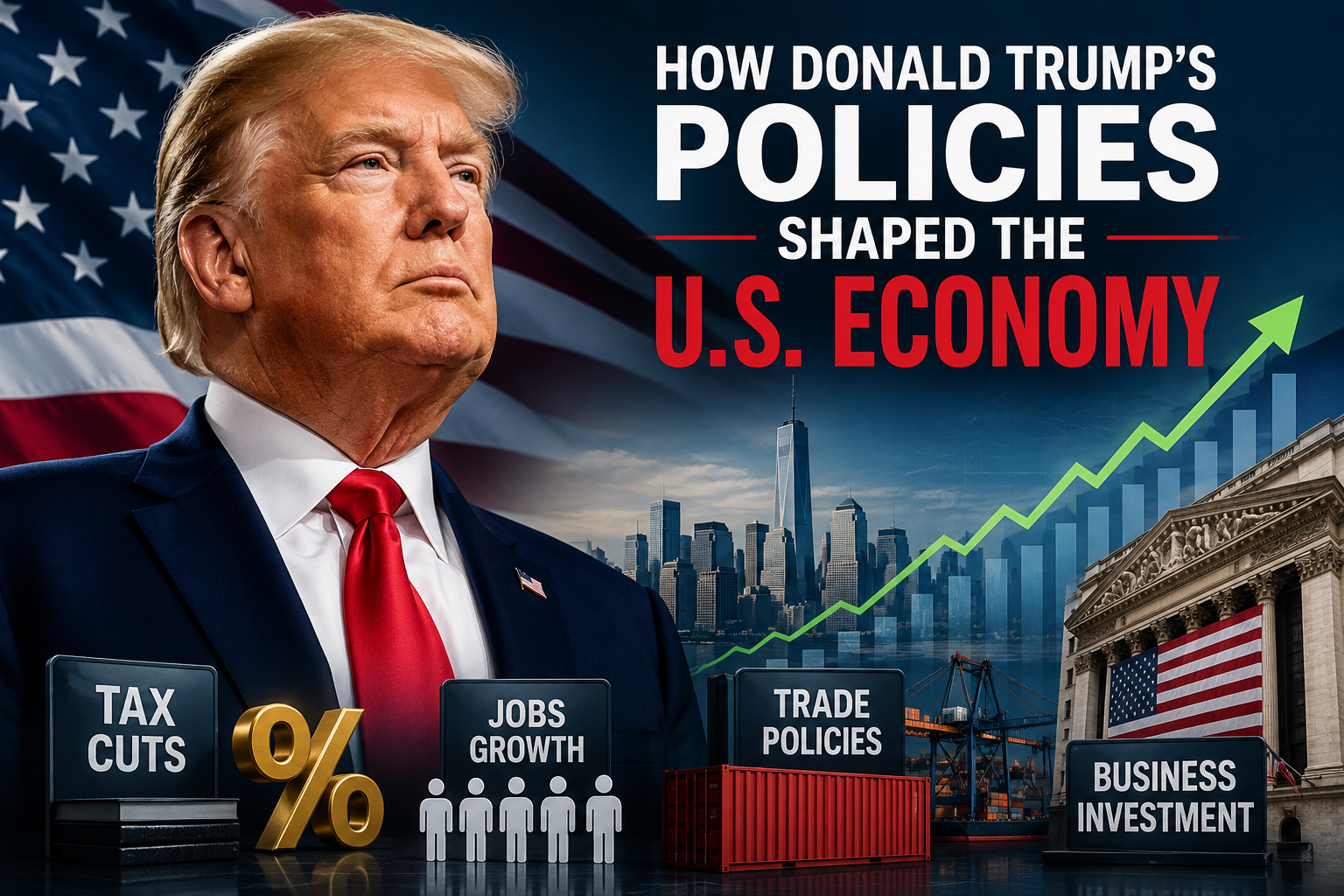
Few modern American presidents have influenced economic debate as strongly as Donald Trump.
Supporters often associate his leadership with tax cuts, deregulation, job creation, and a tougher approach to international trade. Critics point to rising federal debt, tariff-related costs, economic uncertainty, and policies that did not benefit every industry or household equally.
Both perspectives capture part of the story.
Trump’s economic record cannot be reduced to a simple claim that the economy was either exceptionally strong or deeply damaged. His policies encouraged investment in some areas, disrupted established trade relationships, changed how businesses planned for the future, and reshaped the broader political conversation about taxes, manufacturing, energy, and globalization.
Understanding that record requires looking beyond slogans and examining how the major policies actually worked.
The Economy Trump Inherited
When Donald Trump entered the White House in January 2017, the United States was already several years into an economic expansion that had begun after the 2008 financial crisis.
Employment had been improving, consumer spending was growing, and financial markets had recovered substantially. Trump therefore did not begin with a collapsed economy. He inherited an expansion and attempted to accelerate it through lower taxes, reduced regulation, increased domestic energy production, and a more confrontational trade strategy.
This distinction matters because presidents influence economic conditions, but they do not create them from scratch.
Economic performance reflects decisions made by businesses, consumers, Congress, the Federal Reserve, previous administrations, and events taking place around the world. A president can change the direction of policy, but no administration controls every force affecting growth, inflation, employment, or financial markets.
The Tax Cuts and Jobs Act
The Tax Cuts and Jobs Act of 2017 was the centerpiece of Trump’s first-term economic agenda.
The law permanently reduced the federal corporate income tax rate from 35% to 21% and changed taxes for individuals, businesses, and multinational companies. Its goal was to make the United States more attractive for investment, encourage companies to expand, and leave households with more disposable income.
For businesses, the lower corporate rate improved the potential return on investments made in the United States. Some companies increased capital spending, raised wages, paid bonuses, or repurchased shares.
The Congressional Budget Office projected that the law would raise investment, employment, and economic output compared with what would have occurred without it. However, it also estimated that the legislation would increase federal deficits substantially over the following decade.
This illustrates one of the most important trade-offs in tax policy.
Lower taxes can support short-term demand and encourage private investment, but they also reduce government revenue unless faster economic growth or spending reductions make up the difference. In this case, the projected growth effects were not large enough to fully cover the cost of the tax cuts.
Economic Growth Before the Pandemic
The U.S. economy expanded during the first three years of Trump’s presidency.
Real GDP grew by 2.9% in 2018, up from 2.2% in 2017. Growth then slowed to 2.3% in 2019.
These figures show that the economy performed reasonably well, particularly in 2018, but they also challenge the idea that the United States entered an entirely new era of permanently higher growth.
The tax cuts and increased government spending provided a temporary boost. Consumer confidence was generally strong, unemployment remained low, and businesses benefited from favorable financial conditions.
Still, economic growth was beginning to moderate before the COVID-19 pandemic arrived.
That does not mean Trump’s policies failed. It means that large economies rarely respond to policy changes in a perfectly straight line. A major tax cut may increase investment without permanently transforming the economy’s underlying growth rate.
Employment and Wages
Employment was one of the strongest parts of the pre-pandemic economy.
Companies continued hiring, unemployment fell, and many workers benefited from a competitive labor market. Lower-paid employees also began seeing stronger wage growth as businesses found it more difficult to fill open positions.
Trump frequently presented these results as evidence that his policies had created a historic economy.
His administration deserves some credit for maintaining an environment in which businesses felt confident enough to invest and hire. At the same time, the employment expansion had begun years earlier, so it would be misleading to attribute the entire improvement to policies introduced after 2017.
This is a common problem in political discussions about the economy. Presidents are often credited for every positive trend that occurs during their time in office and blamed for every negative one, even when those trends began long before they arrived.
Deregulation and Business Confidence
Another major part of Trump’s strategy was deregulation.
His administration reduced or revised rules affecting energy, finance, environmental policy, construction, and other industries. The argument was that excessive regulation increased costs, delayed investment, and made American companies less competitive.
For some businesses, fewer regulatory requirements created greater flexibility and reduced compliance costs. Energy producers, manufacturers, and smaller companies were among the groups that generally welcomed the change in direction.
However, deregulation also involves trade-offs.
Rules that create costs for businesses may also protect workers, consumers, financial stability, or the environment. Eliminating regulation can improve efficiency, but poorly designed deregulation may shift risks away from companies and toward the public.
The real question is therefore not whether regulation is always good or always bad. It is whether each rule produces benefits that justify its costs.
Tariffs and the Trade War With China
Trump’s trade policy represented a major break from the approach taken by many previous U.S. presidents.
He argued that existing trade agreements had encouraged companies to move production overseas, weakened American manufacturing, and allowed countries such as China to take advantage of the United States.
His administration imposed tariffs on steel, aluminum, Chinese products, and other imports. In response, several trading partners placed retaliatory tariffs on American goods.
The objective was to protect domestic industries, pressure foreign governments, and encourage companies to produce more inside the United States.
Some American producers benefited from reduced foreign competition. Steel manufacturers, for example, received greater protection from imported products.
But tariffs also raised costs for U.S. companies that depended on imported materials and components. Research from the Federal Reserve found that the 2018 tariff increases were associated with higher producer prices and relative declines in manufacturing employment in industries exposed to the new trade barriers and foreign retaliation.
This may seem surprising at first.
A policy designed to help manufacturers can also hurt them when those manufacturers need imported machinery, metals, electronics, or parts. Protecting one part of the economy may increase costs for another.
Did China Pay the Tariffs?
Trump often described tariffs as payments made by foreign countries to the United States.
In practice, tariffs are collected from the American businesses importing the affected products. Those companies must then decide whether to absorb the added cost, negotiate lower prices from foreign suppliers, reduce hiring or investment, or pass the expense on to consumers.
Foreign producers may bear part of the burden when they lower their prices to remain competitive. But the idea that foreign governments simply send tariff payments to the U.S. Treasury does not accurately describe how the system works.
The ultimate cost is usually divided among importers, overseas suppliers, businesses, workers, and consumers.
That is why tariffs can protect selected industries while still increasing prices elsewhere in the economy.
Energy Policy
Trump placed strong emphasis on oil, natural gas, coal, pipelines, and domestic energy production.
His administration reduced environmental restrictions, supported drilling, and promoted what it described as American energy dominance.
Greater domestic production can strengthen energy security, create jobs, increase exports, and reduce dependence on foreign suppliers. It may also help limit energy prices when supply grows faster than demand.
On the other hand, expanding fossil-fuel production creates long-term environmental concerns and may slow investment in cleaner technologies.
The economic effects of energy policy are rarely limited to the price of gasoline. They influence manufacturing costs, transportation, electricity, international trade, regional employment, and investment decisions that may last for decades.
The COVID-19 Economic Collapse
Any evaluation of Trump’s first-term economy must address the COVID-19 pandemic.
In 2020, businesses closed, travel collapsed, unemployment surged, and economic activity fell dramatically. The downturn was caused primarily by a global health emergency rather than ordinary tax, trade, or regulatory policy.
The Trump administration and Congress responded with enormous emergency programs, including direct payments to households, expanded unemployment assistance, loans to businesses, and support for financial markets.
These measures helped prevent an even deeper collapse and gave many households and companies enough financial support to survive the most severe phase of the crisis.
They also contributed to a dramatic increase in federal spending and debt.
Later inflation cannot reasonably be attributed to one president or one policy. Pandemic stimulus, supply-chain disruptions, labor shortages, energy shocks, monetary policy, global conflict, and changes in consumer demand all played a role.
Economic history is usually more complicated than political advertising suggests.
Federal Debt and Deficits
Trump entered office promising stronger growth and criticizing the size of the national debt.
Nevertheless, federal deficits increased during his first term, even before the pandemic. Tax reductions lowered government revenue, while federal spending continued to rise.
The pandemic then produced extraordinary emergency borrowing.
It is important to distinguish between borrowing during a national crisis and running large deficits during normal economic conditions. Emergency spending in 2020 was intended to prevent widespread business failures and household hardship.
The more difficult question is why the government was already borrowing heavily when unemployment was low and the economy was still expanding.
Running large deficits during good economic periods leaves the country with less financial flexibility when a genuine crisis arrives.
The Second Trump Administration
After returning to office in January 2025, Trump again placed tariffs, tax policy, deregulation, energy production, and domestic manufacturing at the center of his economic agenda.
The renewed tariff strategy was broader than the approach used during his first term. Its supporters argued that higher import costs would encourage companies to relocate factories, strengthen American supply chains, and reduce dependence on foreign competitors.
The early effects were mixed.
Some industries gained stronger protection and new incentives to invest domestically. Other companies faced higher costs, delayed expansion plans, or struggled to predict how trade rules would change.
Federal Reserve research found evidence that tariffs introduced in 2025 were passing through to consumer prices, although the transmission appeared slower and weaker than during the earlier tariffs on China.
This reflects a broader reality about trade policy: tariffs can encourage long-term changes in production, but businesses cannot rebuild global supply chains overnight.
A company may need years to find suppliers, construct factories, train workers, and begin manufacturing at scale.
Why Economists Disagree About Trump’s Policies
Economists disagree about Trump’s economic record because they do not always prioritize the same outcomes.
One analyst may focus on tax competitiveness, investment, domestic energy, and reduced regulation. Another may emphasize inequality, federal debt, consumer prices, environmental risks, and trade disruption.
Both may be examining real effects.
Economic policies often create winners and losers at the same time. A tariff may help a domestic producer but hurt a retailer. A tax cut may encourage investment but increase the deficit. Deregulation may lower business costs while creating risks that do not become visible for years.
This is why serious economic analysis rarely produces simple answers.
How Trump Changed the Economic Debate
Perhaps Trump’s most lasting economic influence is not a single statistic but the way he changed the national conversation.
Before his rise, many political leaders treated globalization, expanding trade, and internationally distributed supply chains as largely unavoidable.
Trump challenged that consensus.
He pushed issues such as manufacturing decline, dependence on China, trade deficits, border enforcement, energy independence, and the economic consequences of moving production overseas into the center of American politics.
Even many politicians who strongly oppose him now support a more cautious approach to China and a greater emphasis on domestic manufacturing.
In that sense, Trump’s influence extends beyond the policies enacted during his administrations. He changed the questions American leaders are expected to answer.
The Bigger Picture
Donald Trump’s policies shaped the U.S. economy through lower taxes, deregulation, expanded energy production, aggressive tariffs, emergency pandemic spending, and a renewed focus on domestic manufacturing.
The results were neither entirely positive nor entirely negative.
Tax cuts supported investment and economic activity but increased projected deficits. Deregulation reduced costs for some businesses but raised concerns about long-term risks. Tariffs protected selected industries but increased expenses for companies and consumers elsewhere. Employment remained strong before the pandemic, though the expansion had started before Trump took office.
The most honest assessment is that Trump changed both economic policy and the way Americans think about the economy.
His approach rejected the idea that free trade, global supply chains, and conventional economic policy should remain largely untouched. Whether that shift ultimately makes the United States stronger will depend not only on political promises, but on investment, productivity, innovation, fiscal discipline, and the ability of American companies to compete.
Presidents can shape the environment in which an economy operates. They can influence taxes, trade, regulation, energy, and government spending. But lasting prosperity still depends on millions of workers, consumers, entrepreneurs, and businesses making decisions every day.
That is the part of the economy no president controls alone.
Continue Reading
Finance Atlas
Demystifying global markets, compounding structural wealth.
Sitemap
Home
Articles
Categories
About
Contact
Privacy
Inquiries
financeatlascontact@gmail.com
Response within one business day
© 2026 Finance Atlas-Independent financial intelligence.
Institutional Authority. Clear Utility.