
The History of Money: From Barter to Digital Currency
Explore the history of money, from barter and ancient coins to paper currency, banking, credit cards, cryptocurrencies, and digital payments.
7/21/202611 min read
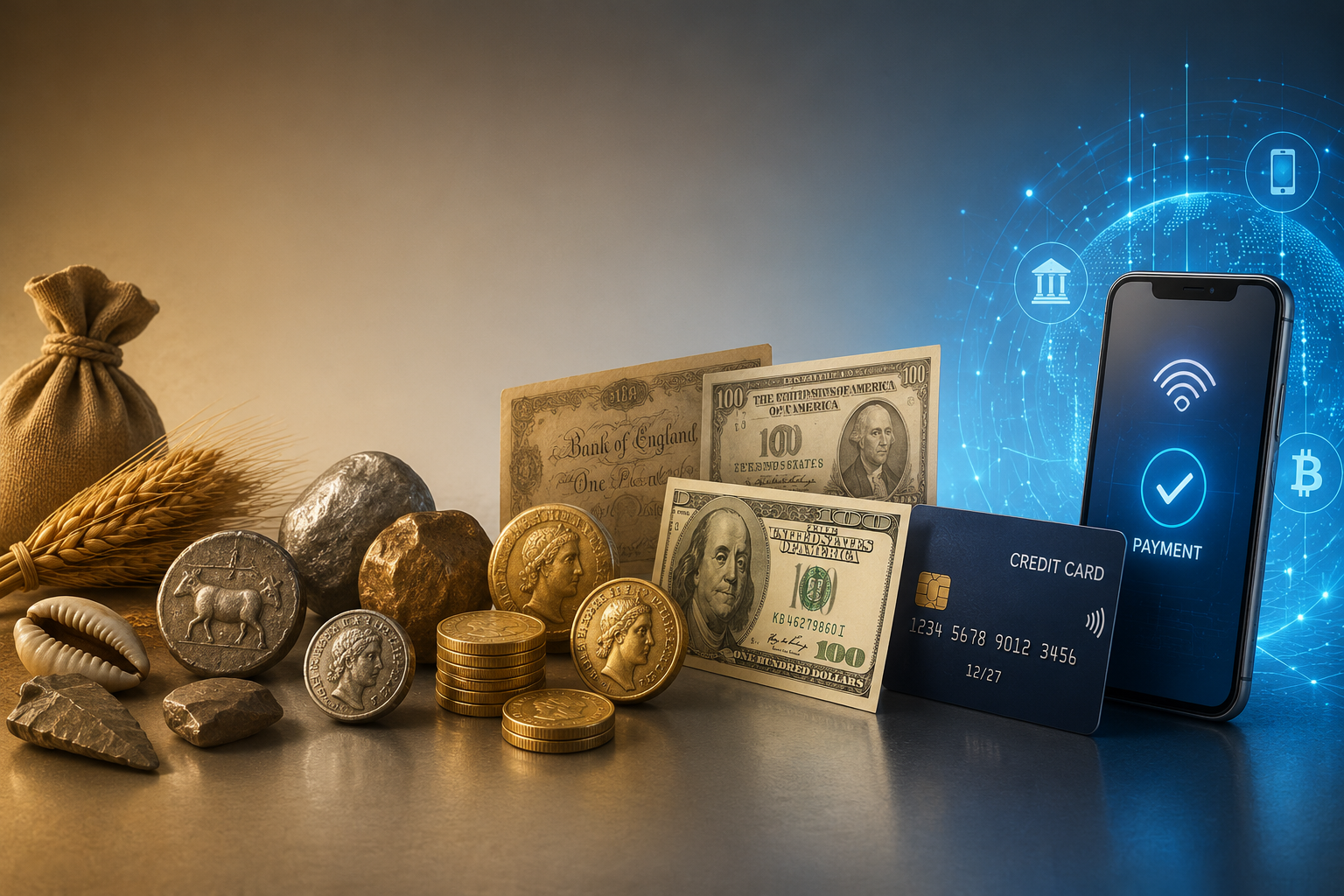
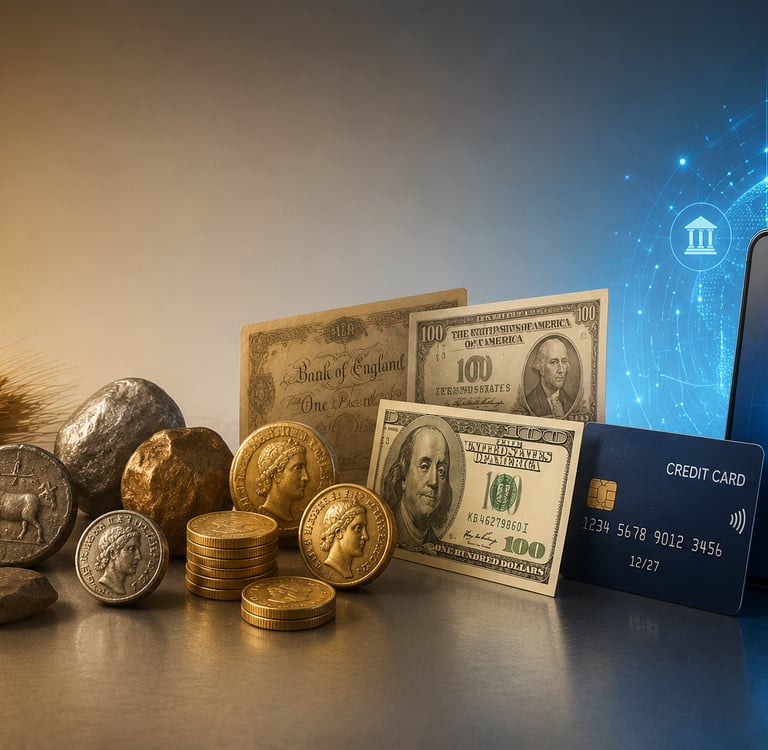
Money is so deeply connected to everyday life that most people rarely stop to think about what it actually is.
We earn it, save it, spend it, invest it, and sometimes worry about not having enough of it. Yet the money in a modern bank account looks nothing like the shells, metal coins, and handwritten promises used by earlier civilizations.
The history of money is not simply the story of replacing one object with another. It is the story of people searching for faster, safer, and more reliable ways to exchange value.
Barter gave way to commodities. Commodities were gradually replaced by standardized coins. Coins were supplemented by paper notes, and paper notes eventually became electronic balances stored inside financial systems.
Today, money can move across the world in seconds without any physical currency changing hands.
The technology has changed dramatically, but the basic requirement has remained surprisingly consistent: money only works when people trust that others will accept it.
What Is Money?
Money is anything widely accepted as payment for goods, services, and debts.
To function effectively, it generally needs to serve three important purposes:
A medium of exchange.
A unit of account.
A store of value.
As a medium of exchange, money allows people to buy and sell without directly trading one product for another.
As a unit of account, it provides a common way to compare prices. A customer can easily understand the difference between a $10 item and a $100 item because both are measured using the same standard.
As a store of value, money allows purchasing power to be saved and used later, although inflation can gradually reduce how much that money can buy.
The form of money may change, but these basic functions remain at the center of every successful monetary system.
Life Before Standardized Money
Before standardized currencies became common, people exchanged value in several ways.
Some transactions involved barter, where one good or service was traded directly for another. A farmer might exchange grain for tools, while a craftsperson could provide work in return for food or livestock.
Barter can work well when both sides want exactly what the other person offers.
The difficulty appears when their needs do not match.
A fisherman may want a pair of shoes, but the shoemaker may not want fish. The fisherman must then find something the shoemaker will accept or complete several separate trades before obtaining the shoes.
Economists often describe this problem as the need for a “double coincidence of wants.”
It is one of the clearest reasons societies benefited from creating a commonly accepted medium of exchange.
Still, history did not follow a perfectly straight path from barter to money. Direct trade, informal credit, gifts, debts, and early forms of currency often existed at the same time.
Money developed gradually because different communities needed different solutions.
The Rise of Commodity Money
One early solution was commodity money.
Instead of exchanging any available product, communities began using particular objects that were widely valued and relatively easy to trade.
Depending on the location and period, people used:
Salt.
Grain.
Livestock.
Animal skins.
Beads.
Metal tools.
Cowrie shells.
Gold and silver.
Cowrie shells, for example, circulated as money across parts of Africa, Asia, and other regions for extremely long periods. Their popularity came partly from their durability, recognizable appearance, and limited availability.
Commodity money made trade easier, but it was far from perfect.
Livestock was difficult to divide into small payments. Grain could spoil. Shells and beads were not equally valuable everywhere. Precious metals were more durable, but their weight and purity had to be checked during transactions.
These limitations created demand for a more standardized form of money.
How Coins Changed Trade
Coins solved several problems that commodity money could not.
Instead of weighing pieces of metal during every transaction, governments and rulers could produce standardized pieces with an official weight, material, and symbol.
The mark stamped on a coin acted as a form of certification.
It told users that an authority stood behind the coin and claimed that it contained a certain amount of valuable metal.
Some of the earliest widely recognized coins were produced in Lydia, an ancient kingdom located in what is now western Turkey. Early Lydian coins were made from electrum, a natural mixture of gold and silver.
Coins made commerce faster because they were durable, portable, divisible, and easier to count than many earlier commodities.
They also allowed rulers to collect taxes, pay soldiers, and finance larger governments more efficiently.
Interestingly, coins were more than economic tools.
The images placed on them communicated political power, religious beliefs, and national identity. A coin could travel far beyond the territory where it was created, carrying the authority and reputation of its issuer with it.
Money was already becoming a form of communication.
The Problem With Carrying Metal
Coins improved trade, but they created another difficulty.
Large transactions required large quantities of metal.
Carrying enough gold or silver to purchase land, finance a business, or trade across long distances was inconvenient and dangerous. Valuable metal could be lost, stolen, or damaged during travel.
Merchants began storing coins and precious metals with trusted institutions or individuals.
In return, they received written receipts confirming how much had been deposited.
Over time, people discovered that exchanging the receipt was often easier than withdrawing the metal and handing it to someone else.
This was a major turning point.
A piece of paper had begun to represent valuable property stored somewhere else.
The paper itself was not worth much. Its value came from the promise behind it.
The Development of Paper Money
Paper money developed in China centuries before it became common in Europe.
Chinese merchants used paper receipts because transporting large amounts of heavy metal currency was difficult. By the 11th century, government-issued paper money had emerged in China, creating one of history’s earliest large-scale banknote systems.
The idea was powerful but required trust.
People had to believe that the paper could be exchanged, spent, or used to settle debts. They also needed confidence that the issuer would not create so many notes that the currency lost its value.
European banks later developed similar systems based on deposits of gold and silver.
When the Bank of England was founded in 1694, it accepted gold coins and issued paper notes in return. Those notes could be used for payments because holders trusted that they could exchange them for gold.
Paper money was lighter, easier to transport, and more practical for large transactions.
But it also introduced a lesson that remains relevant today: the usefulness of money depends less on the material from which it is made than on confidence in the institution supporting it.
Banking, Credit, and the Expansion of Money
As banks became more important, money began moving beyond physical coins and notes.
Customers placed funds in bank accounts and transferred ownership through written instructions, bills of exchange, and eventually checks.
Banks also discovered that depositors rarely demanded all their money at the same time.
This allowed financial institutions to lend part of the funds they received, helping businesses invest, households purchase property, and economies expand.
Modern commercial banks do more than store existing money. When they approve loans, they generally create new bank deposits in the process.
This means much of the money used in modern economies is not physical cash produced by a mint or printing facility. It exists as records on bank balance sheets.
That may sound abstract, but the principle is familiar.
When a salary enters a bank account, the account holder rarely receives a physical stack of cash. The balance simply changes electronically, yet it can still be used to pay bills, buy products, or transfer money.
The money is real because the financial system recognizes the claim.
Gold, Convertibility, and Monetary Discipline
For long periods, many paper currencies were connected to precious metals.
Under a gold standard, a country defined its currency in relation to a fixed amount of gold. In theory, holders could exchange paper notes for the metal supporting them.
Supporters of this system valued the discipline it imposed.
Because governments needed gold reserves, they could not expand the money supply without limits.
However, the gold standard also restricted the ability of governments and central banks to respond to financial crises, recessions, and rapidly changing economic conditions.
If the economy needed more money and credit but the gold supply did not increase, the monetary system could become inflexible.
During the 20th century, major economies gradually moved away from direct gold convertibility.
The transition was controversial, but it created the modern system of fiat money.
What Is Fiat Money?
Fiat money is currency that is not directly redeemable for gold, silver, or another commodity.
The U.S. dollar, euro, British pound, Brazilian real, and most other modern national currencies are forms of fiat money.
A dollar bill has very little value as a physical object.
Its purchasing power comes from the fact that people accept it, businesses price goods in it, governments recognize it for tax payments, and financial institutions use it to settle transactions.
Central banks also play a crucial role by managing the monetary system and attempting to maintain price stability.
Fiat money is sometimes described as being “backed by nothing,” but that explanation is incomplete.
It is backed by institutions, laws, taxation systems, economic activity, and public confidence.
That does not make fiat currency immune to failure. Governments can damage confidence by creating money irresponsibly, mismanaging public finances, or allowing inflation to become uncontrollable.
But physical backing alone has never eliminated monetary problems either.
Every form of money ultimately depends on credibility.
Money Becomes Electronic
Long before cryptocurrencies appeared, most money had already become digital.
Bank accounts, wire transfers, credit cards, debit cards, and electronic payment networks allowed value to move without physical notes or coins.
When someone pays with a debit card, no banknote travels from the buyer to the store.
Financial institutions simply update electronic records showing that one account has less money and another has more.
Online banking accelerated this transformation.
Consumers could check balances, pay bills, and transfer money without visiting a bank branch. Smartphones then made these services available almost anywhere.
In many developed economies, the majority of money is now held electronically as commercial bank deposits rather than as physical cash. The Bank of England, for example, reports that approximately 96% of money in the United Kingdom is held electronically.
This reveals something important.
Digital money is not a recent invention. What is changing now is the technology used to create, transfer, and verify it.
Credit Cards and the Separation of Payment From Cash
Credit cards introduced another major shift.
They allowed consumers to make purchases using borrowed money rather than funds already held in their accounts.
The merchant received payment through a financial network, while the customer promised to repay the card issuer later.
This made spending more convenient and expanded access to short-term credit.
It also created new risks.
Convenience can make spending feel less immediate. Handing over physical cash creates a visible sense of loss, while tapping a card or clicking a payment button can feel almost effortless.
The money is still being spent, but the psychological experience is different.
Technology does not only change how transactions are processed. It can also change how people behave.
The Internet Transforms Payments
The growth of the internet created new payment companies and financial services.
Online platforms made it possible to send money to individuals, purchase products from businesses in other countries, and manage financial accounts without entering a traditional bank.
Companies such as PayPal helped make digital transfers easier for ordinary consumers by connecting bank accounts and payment cards to simple online interfaces. More recently, real-time payment systems have reduced the time required for money to move between financial institutions.
These services did not necessarily create a new form of national money.
They created faster ways to access and transfer money that already existed inside the banking system.
That distinction matters.
A digital payment method and a digital currency are not always the same thing.
Bitcoin and the Arrival of Cryptocurrency
A more radical experiment appeared with Bitcoin.
The Bitcoin white paper, published under the name Satoshi Nakamoto in 2008, described a peer-to-peer electronic cash system that could operate without a central financial institution controlling every transaction. The network began operating in 2009.
Bitcoin uses a decentralized ledger known as a blockchain.
Instead of one bank maintaining the official record, a distributed network verifies and records transactions according to the system’s rules.
This introduced a new idea into the history of money: digital scarcity.
Files can usually be copied endlessly. Bitcoin created a system in which digital units could not simply be duplicated and spent repeatedly.
Its supporters view it as an alternative to government-controlled currency and a possible store of value.
Critics point to price volatility, energy use, regulatory uncertainty, and the difficulty of using it for ordinary transactions.
Both sides highlight an important truth.
Creating a new form of money is technically possible. Convincing millions of people to trust and use it consistently is much harder.
Stablecoins
Stablecoins attempt to address one of cryptocurrency’s biggest weaknesses: volatility.
They are digital tokens designed to maintain a stable value, commonly by linking each unit to a traditional currency such as the U.S. dollar.
A dollar-backed stablecoin aims to remain worth approximately one dollar.
This can make stablecoins more practical for payments, trading, savings, and international transfers than cryptocurrencies whose prices change dramatically.
However, the stability depends on how the token is managed.
Users must trust that the issuer actually holds sufficient reserves, protects those assets, honors redemptions, and follows appropriate regulations.
In that sense, stablecoins may use modern technology, but they face an old monetary problem.
A promise is only as reliable as the institution making it.
Central Bank Digital Currencies
Central bank digital currencies, commonly known as CBDCs, represent another possible stage in the evolution of money.
A CBDC is a digital form of money issued by a central bank.
Unlike Bitcoin, it would not normally be decentralized. Unlike a balance issued by a private payment company, it would represent a direct form of public money.
Governments and central banks are studying CBDCs for several reasons, including faster payments, financial inclusion, payment-system resilience, and the declining use of physical cash in some countries.
Interest is widespread. A Bank for International Settlements survey published in 2025 found that 91% of the 93 surveyed central banks were exploring a retail CBDC, a wholesale CBDC, or both.
Yet CBDCs also raise difficult questions.
How much transaction data should authorities be able to see?
How should personal privacy be protected?
Could people move money out of commercial banks too quickly during a financial crisis?
Would a digital currency replace cash or simply exist alongside it?
The answers will determine whether CBDCs become a major part of everyday life or remain limited to particular financial uses.
Will Physical Cash Disappear?
Digital payments continue to grow, but that does not mean cash will disappear immediately.
Cash still offers important advantages.
It can be used without electricity, internet access, a bank account, or a digital device. It provides privacy in ordinary transactions and remains useful during technical disruptions.
It is also important for people who have limited access to digital banking.
The European Central Bank emphasizes that cash can be used when power or payment systems are unavailable and continues to support financial inclusion for vulnerable groups.
The future of money may therefore involve coexistence rather than complete replacement.
Cash, bank deposits, private digital payment systems, stablecoins, cryptocurrencies, and central bank digital currencies may serve different purposes at the same time.
Money has rarely evolved by making every older form disappear overnight.
Why Trust Matters More Than Technology
A cowrie shell, gold coin, paper banknote, bank deposit, and digital token appear completely different.
Yet they all depend on the same basic question:
Will someone else accept this from me later?
Money works because people share expectations.
They believe that employers will pay them in it, stores will accept it, governments will recognize it, and financial institutions will help transfer it.
Technology can make money faster, cheaper, and more convenient.
It cannot eliminate the need for trust.
Even decentralized systems replace one kind of trust with another. Instead of trusting a bank or government, users may trust software, cryptography, network participants, and the rules written into the system.
The institution may change, but confidence remains essential.
The Bigger Picture
The history of money is often presented as a simple journey from barter to coins, from coins to paper, and from paper to digital currency.
The real story is more interesting.
Each stage developed because the previous system could not fully meet the needs of a growing economy.
Barter struggled when people wanted different things. Commodity money lacked consistency. Metal coins became inconvenient for large transactions. Paper money required trusted issuers. Banking increased access to credit but created financial risks. Digital payments improved speed while increasing dependence on technology.
Cryptocurrencies and central bank digital currencies are now attempting to solve new problems, but they are also creating new questions.
That pattern is unlikely to end.
The future form of money may involve technologies that are still being developed. Transactions may become faster, more programmable, and more deeply connected to global digital networks.
But the purpose of money will remain familiar.
People will still need a way to measure value, exchange it, and preserve it for the future.
Money has changed from physical objects into entries on digital ledgers, yet its real foundation has never been paper, metal, or computer code.
It has always been trust.
Continue Reading
Finance Atlas
Demystifying global markets, compounding structural wealth.
Sitemap
Home
Articles
Categories
About
Contact
Privacy
Inquiries
financeatlascontact@gmail.com
Response within one business day
© 2026 Finance Atlas-Independent financial intelligence.
Institutional Authority. Clear Utility.