
What Are Assets and Liabilities? A Simple Guide for Beginners
Learn the difference between assets and liabilities, how they affect your net worth, and why building valuable assets while controlling debt is one of the most important steps toward financial freedom.
FINANCIAL EDUCATIONBEGINNER GUIDES
7/25/20268 min read
Two people can earn exactly the same salary and still end up in completely different financial situations.
One uses part of every paycheck to buy investments, build savings, and reduce debt.
The other increases spending, finances expensive purchases, and accumulates monthly payments.
From the outside, the second person may appear wealthier.
Behind the scenes, the first person is quietly building something far more valuable: ownership.
The difference often comes down to two simple concepts—assets and liabilities.
Understanding them will not make you rich overnight. But ignoring them can cause years of hard work to produce surprisingly little wealth.
What Is an Asset?
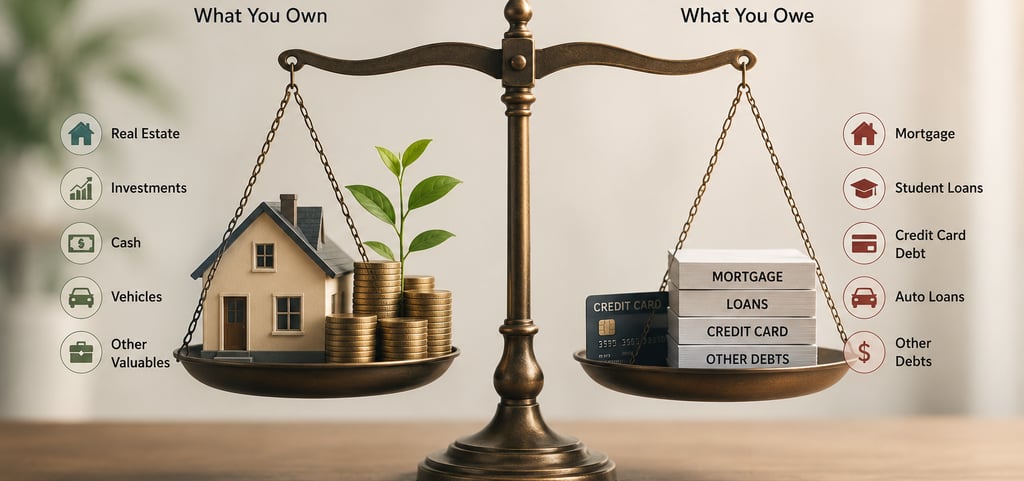
An asset is something you own that has economic value.
It may be money, property, an investment, equipment, or another resource that can be sold, used, or expected to provide a future financial benefit.
The SEC explains that assets are things a company owns that have value, including cash, investments, property, equipment, inventory, and money owed by customers.
For an individual, common assets may include:
Cash in checking and savings accounts
Stocks and investment funds
Bonds
Retirement accounts
Real estate
Business ownership
Vehicles
Valuable equipment
Intellectual property
Collectibles with a genuine resale market
At first glance, the idea appears simple: if you own it and it is worth money, it may be an asset.
But not all assets help you build wealth in the same way.
Some increase in value or produce income.
Others gradually lose value while creating additional expenses.
That difference matters.
What Is a Liability?
A liability is a financial obligation you owe to another person, company, lender, or institution.
In personal finance, liabilities commonly include:
Credit-card balances
Mortgages
Student loans
Personal loans
Vehicle loans
Unpaid taxes
Medical debt
Buy-now-pay-later balances
Money borrowed from other people
For businesses, liabilities may also include money owed to suppliers, employee wages payable, taxes, leases, and other obligations.
A balance sheet records assets, liabilities, and equity at a particular point in time.
A liability does not automatically mean you made a terrible decision.
A mortgage may help someone purchase a home. A business loan may finance equipment that increases profits. Student debt may support education that improves earning potential.
The real question is not simply whether you have debt.
It is whether that debt helps strengthen your financial future—or quietly weakens it.
The Simplest Difference
The basic difference is:
An asset is something valuable you own.
A liability is something you owe.
If you have $20,000 in investments, those investments are assets.
If you owe $8,000 on a personal loan, that debt is a liability.
This difference becomes especially important when calculating your net worth.
How Assets and Liabilities Determine Net Worth
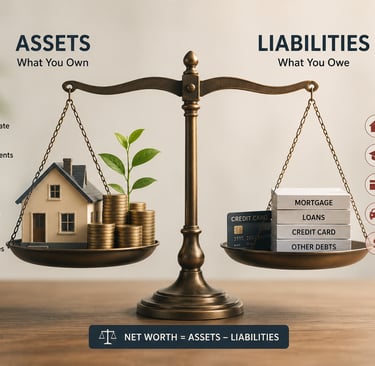
Your net worth is calculated by subtracting your total liabilities from your total assets:
Net Worth = Total Assets − Total Liabilities
The Consumer Financial Protection Bureau describes net worth as the difference between what you own and what you owe.
Imagine you have:
Assets
$10,000 in savings
$25,000 in investments
A car worth $15,000
A home worth $250,000
Your total assets equal $300,000.
Liabilities
$210,000 remaining on the mortgage
$8,000 in student loans
$5,000 remaining on the vehicle loan
$2,000 in credit-card debt
Your total liabilities equal $225,000.
Your net worth would therefore be:
$300,000 − $225,000 = $75,000
This number provides a clearer picture of financial strength than income alone.
A high salary shows how much money enters your life.
Net worth shows how much financial value remains after your obligations are considered.
Assets Are Not Always Income-Producing
A common financial phrase says that assets put money into your pocket while liabilities take money out.
That idea can be useful, but it is not a complete accounting definition.
A car can be an asset because it has resale value, even though it requires fuel, insurance, maintenance, and repairs.
A home can be an asset because it has market value, even though it may come with mortgage payments, property taxes, and maintenance costs.
An investment property may be an asset while the mortgage attached to it is a liability.
This is an important distinction.
Something does not stop being an asset simply because it creates expenses.
However, when your goal is building wealth, you should pay special attention to assets that can:
Increase in value
Generate income
Reduce future expenses
Improve your earning ability
Support a profitable business
Owning valuable things is useful.
Owning things that can create additional value is even more powerful.
Productive Assets vs. Depreciating Assets
Not every asset behaves the same way.
Productive Assets
Productive assets have the potential to generate income or grow in value.
Examples may include:
Shares in profitable companies
Diversified investment funds
Bonds that pay interest
Rental property producing positive cash flow
A profitable business
Equipment used to earn income
Intellectual property producing royalties
These assets may help your money create more money.
They still involve risk. Stocks can decline, businesses can fail, tenants can leave, and property values can fall.
But productive assets have the potential to strengthen your financial position without depending entirely on your next paycheck.
Depreciating Assets
Depreciating assets generally lose value over time.
Examples may include:
Cars
Electronics
Furniture
Appliances
Certain luxury products
These things may still be necessary or enjoyable.
A car can help you commute to work. A computer can help you earn income. Furniture can improve your daily life.
The problem begins when someone repeatedly borrows large amounts to purchase depreciating assets they cannot comfortably afford.
The purchase provides immediate satisfaction.
The payments remain long after the excitement disappears.
Good Debt and Bad Debt
Debt is often divided into “good debt” and “bad debt.”
The labels are imperfect, but the underlying idea is useful.
Debt That May Create Value
Debt may be productive when it helps purchase or develop something capable of generating more value than the total borrowing cost.
Examples could include:
A carefully chosen business loan
A reasonably priced mortgage
Education connected to stronger career opportunities
Financing for equipment that increases business revenue
Even these debts carry risk.
A business may fail. A home may lose value. A qualification may not increase income as expected.
Borrowing money does not guarantee progress.
It only creates an obligation that must be justified by the potential benefit.
Debt That Usually Weakens Wealth
Debt becomes especially dangerous when it finances short-lived consumption at high interest rates.
Examples may include:
Carrying credit-card balances for unnecessary purchases
Financing expensive vacations
Repeatedly replacing vehicles before old loans are repaid
Using personal loans to maintain an unaffordable lifestyle
Borrowing to speculate on highly volatile investments
The item may disappear, break, or lose value.
The debt remains.
That is one of the most painful financial combinations: paying interest today for something that no longer improves your life.
Why Monthly Payments Can Be Misleading
Many purchases are advertised according to the monthly payment rather than the total cost.
A car may appear affordable at $500 per month.
A new phone may cost “only” $40 per month.
Furniture may be offered through several small installments.
Looking only at the payment can hide the real financial impact.
Before accepting a new liability, ask:
What is the total purchase price?
How much interest will I pay?
How long will the payment continue?
Will the item still have meaningful value when the debt is repaid?
What opportunities am I giving up by committing this money?
Could I comfortably make the payment after losing part of my income?
A monthly payment tells you whether the purchase fits into this month’s budget.
It does not tell you whether the purchase improves your long-term financial position.
Why Wealthy People Focus on Ownership
A salary can provide the money needed to begin building wealth.
But a salary alone does not necessarily create ownership.
When all earned income is spent, the worker must return the following month and earn it again.
Assets can change that relationship.
An investment may produce dividends. A bond may pay interest. A business may generate profits. A rental property may provide income. A valuable skill may increase future earnings.
This does not mean everyone must become an entrepreneur or own multiple properties.
A beginner can start much more simply:
Build emergency savings.
Contribute to a retirement account.
Purchase diversified investments.
Reduce high-interest debt.
Develop skills that increase income.
Avoid unnecessary long-term payments.
The amount may appear small at first.
But every asset purchased increases the portion of your financial life that belongs to you.
Every liability reduced gives your future income more freedom.
How Liabilities Can Control Your Income
When a large percentage of your income is committed to debt payments, your financial choices become limited.
You may want to leave a stressful job, but the mortgage, vehicle loan, and credit-card bills still need to be paid.
You may want to invest, but previous purchases are consuming the money that could have funded those investments.
You may receive a raise, only to discover that most of it is already needed for existing obligations.
This is why liabilities are not only numbers on a balance sheet.
They can influence your time, career decisions, stress, and ability to take opportunities.
A manageable debt can serve a purpose.
Too many liabilities can quietly turn a good income into a financial prison.
Assets Can Provide More Than Money
Assets do not only increase net worth.
They can create options.
Emergency savings may allow you to handle an unexpected expense without borrowing.
Investments may help fund retirement.
Business ownership may create income beyond a salary.
A paid-off home may reduce future housing expenses.
Education and valuable skills may increase your ability to earn.
The strongest assets often provide something deeper than status.
They give you greater control over your life.
That is why a growing investment account may be more valuable than a luxury purchase of the same price, even when nobody else can see it.
One attracts attention today.
The other may protect your freedom tomorrow.
How to Create a Personal Balance Sheet
You can understand your financial position by creating a simple personal balance sheet.
Step 1: List Your Assets
Write down everything you own that has meaningful financial value.
Include:
Cash
Savings
Investments
Retirement accounts
Property
Vehicles
Business ownership
Other valuable possessions
Use realistic current values—not what you originally paid.
A car purchased for $30,000 may now be worth only $18,000.
An investment account should be recorded at its current value.
Step 2: List Your Liabilities
Write down everything you owe.
Include:
Credit cards
Mortgages
Student loans
Car loans
Personal loans
Medical debt
Taxes owed
Other unpaid balances
Use the full outstanding balance, not only the next monthly payment.
Step 3: Calculate Your Net Worth
Add the value of all assets.
Add the value of all liabilities.
Subtract liabilities from assets.
Your first result may be lower than expected—or even negative.
Do not panic.
A balance sheet is not a judgment of your intelligence or personal worth.
It is a starting point.
You cannot change yesterday’s financial decisions, but you can begin changing what the next version of your balance sheet will show.
How to Improve Your Net Worth
There are two primary ways to increase net worth:
Increase your assets.
Reduce your liabilities.
The strongest financial plans often do both.
Practical steps may include:
Saving part of every paycheck
Investing consistently
Reinvesting investment returns
Paying down high-interest debt
Avoiding unnecessary borrowing
Increasing your income
Using raises to purchase assets instead of only upgrading your lifestyle
Protecting important assets with appropriate insurance
Reviewing your net worth regularly
You do not need to make every improvement immediately.
Begin with the area causing the greatest financial pressure.
For one person, that may be credit-card debt.
For another, it may be having no emergency savings.
For someone else, it may be earning a good salary but owning almost no investments.
Progress becomes easier when you know exactly what problem you are solving.
Common Mistakes Beginners Make
Believing Every Expensive Purchase Is an Asset
A high price does not guarantee that something will retain value.
Luxury products, cars, and electronics may lose value rapidly.
Ignoring the Debt Attached to an Asset
A home worth $400,000 does not add $400,000 to your net worth when you still owe $350,000 on the mortgage.
Your equity is the difference.
Confusing Income with Wealth
Income can help you purchase assets.
But if it is entirely spent, it may produce little lasting wealth.
Borrowing to Look Successful
A financed lifestyle can create the appearance of wealth while liabilities quietly grow underneath it.
Investing Before Controlling Dangerous Debt
An uncertain investment return may struggle to overcome a very high guaranteed interest cost on debt.
Never Measuring Net Worth
Without tracking assets and liabilities, it is difficult to know whether your financial position is genuinely improving.
Make Every Paycheck Build Something
You do not need to stop enjoying your money.
You also do not need to treat every liability as a failure.
A comfortable home, reliable transportation, and meaningful experiences can all improve your life.
The goal is balance.
Part of your income supports your life today.
Another part should gradually build the life you want tomorrow.
That means purchasing fewer things only because they create the appearance of success and directing more money toward assets that create security, income, or long-term value.
At first, the difference may be almost invisible.
The person building assets may drive an older car, live in a smaller home, or avoid upgrades that others consider normal.
Years later, the results become harder to ignore.
One person still needs every paycheck to maintain the lifestyle.
The other owns investments, carries less debt, and has more freedom to decide what happens next.
Assets and liabilities are simple concepts.
But the direction they create can shape your entire financial life.
Continue Reading
Finance Atlas
Demystifying global markets, compounding structural wealth.
Sitemap
Home
Articles
Categories
About
Contact
Privacy
Inquiries
financeatlascontact@gmail.com
Response within one business day
© 2026 Finance Atlas-Independent financial intelligence.
Institutional Authority. Clear Utility.